City invests R62m to secure water by clearing invasive alien plants
01 April 2021
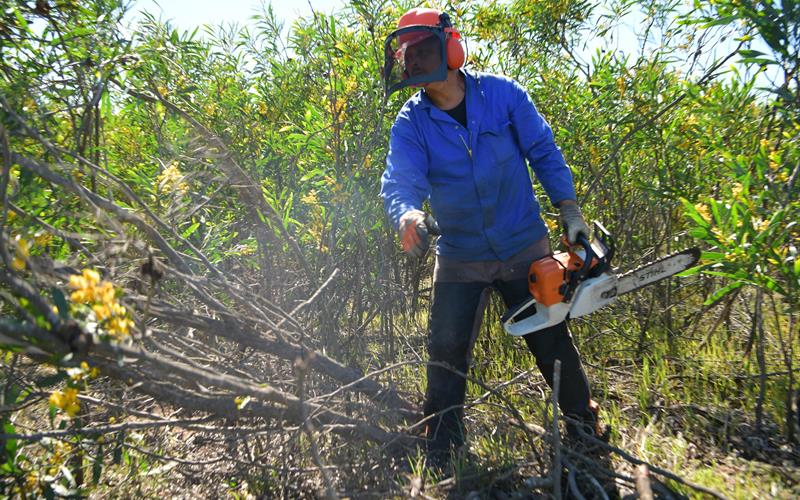
Council yesterday approved a Memorandum of Agreement between the City of Cape Town and The Nature Conservancy which, over the next three years, will see the City investing R62 million to bolster efforts to clear thirsty alien invasive plants (AIPs) in rugged mountainous catchment areas, feeding important water supply dams for Cape Town. Read more below:
Clearing of alien invasive plants is a key component of the City of Cape Town's Water Strategy. By removing water-guzzling plants from key parts of the dam catchment, our surface water supply is maximised as more rain water can flow into the dams.
The City of Cape Town’s Water Strategy aims to build resilience against the effects of climate change, and resulting future droughts to ensure a safe, reliable water supply for generations to come. It was drafted and adopted in response to the City’s worst drought on record, and serves as the foundation for the implementation of the New Water Programme, through which the City has accelerated efforts to diversify our water sources.
The City’s intention to clear AIPs is outlined in both the Water Strategy, and the City of Cape Town Resilience Strategy, reflecting the important role this will play in building resilience against climate change.
While thousands of hectares of invasive trees have been removed to date, it is not enough. To turn the water losses into gains, 54,300 hectares have to be cleared. Scientific reports have shown that over 55 billion litres of water - about two months water for Cape Town - is being lost every year to AIPs such as pines, gums and wattles in catchments feeding City dams. This loss will double to 100 billion litres of water every year, within 20 years, if not addressed.
Clearing AIPs is the most cost effective and sustainable way to secure our water supply and meet future water demands.
Agreement with The Nature Conservancy
The Nature Conservancy (TNC) is a global non-profit environmental organisation working in over 70 countries. In South Africa, the City of Cape and TNC worked together to establish the Greater Cape Town Water Fund in 2018.
Water Funds are public-private partnerships designed to use nature-based solutions for securing water for cities. This is achieved through collective action that ensures good governance, transparency and improved coordination. TNC is matching the City of Cape Town’s R62 million contribution rand-for-rand through contributions raised in the private sector and from philanthropy.
The City currently clears AIPs (pine plantations) in the low-lying Steenbras and Wemmershoek catchments. The City’s contribution of R62 million to the Greater Cape Town Water Fund, administered by TNC, will focus on clearing AIPs on the high angle slopes in the upper reaches of the Wemmershoek, Steenbras and Berg River Dam catchments.
As part of the agreement, TNC will provide the City with regular reports, including a publicly available online tracking tool on the progress of the work.
‘Overall, we look forward to the results that the efforts and hard work will produce over the next three years,’ said the City’s Mayoral Committee Member for Water and Waste, Alderman Xanthea Limberg.
In 2016, the City and TNC entered into a Memorandum of Understanding (MOU) whereby the City invited TNC to explore a Water Fund for the Greater Cape Town Region.
TNC formed a Steering Committee, with representation from the City, National Department of Water and Sanitation (DWS), Western Cape Department of Environmental Affairs and Development Planning (DEA&DP), South African National Biodiversity Institute (SANBI), World Wide Fund for Nature (WWF-SA), CapeNature, Coca-Cola Peninsula Beverages, Remgro Ltd, Nedbank and PepsiCo, to establish the Greater Cape Town Water Fund.
‘The City will continue to work with stakeholders and partners to make the most of opportunities to optimise the economic, social and ecological benefits of regional water resources,’ said Alderman Limberg.
Update on the clearance of alien vegetation in City-managed areas
The City has a history of investing in the removal of AIPs in city-managed areas:
- AIP clearing and rehabilitation in the Steenbras and Wemmershoek catchment is in progress to maximise surface run-off and water yield. The City has cleared approximately 400 hectares of pine plantations thus far and aims to remove a further 130 hectares over the next 18 months.
- As part of the Table Mountain Group Aquifer project, 33 hectares of gum and pine trees were cleared along the route of the pipeline to the wellfield.
- In addition, a partnership programme manages the clearing of AIPs and has been implemented at the Steenbras, Wemmershoek and Atlantis catchment areas, using specialist commercial contractors.
- The programme is managed through the Invasive Species Unit of the Biodiversity Management Branch. Funding for this project has been provided by the City as well as the Greater Cape Town Water Fund via The Nature Conservancy, and Working for Water.
- Over the past two years, over 2 500 hectares have been cleared and maintained, creating 705 short-term work and skills development opportunities.
Through collective action, the City of Cape Town and the Greater Cape Town Water partnership will clear AIPs from 9 000 hectares per year. This project will avoid annual losses of 55 billion litres of water currently being lost to dams supplying the city.
More information about the City’s Water Strategy and the New Water Programme can be found here: http://www.capetown.gov.za/general/cape-town-water-strategy
End
Published by:
City of Cape Town, Media Office